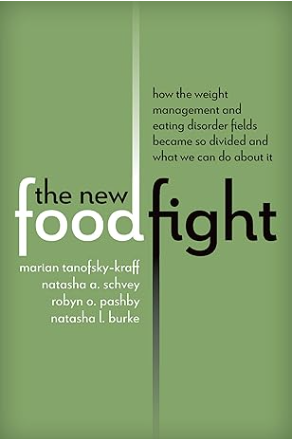
 As a clinician, researcher, and advocate working at the intersection of eating disorder care and weight management, I felt that the authors did an exceptional job honoring and advocating for both perspectives while thoughtfully acknowledging areas of tension and growth within each field. Early in the book, the authors share their own personal accounts of negative weight- or eating-related experiences, communicating understanding and empathy. They then provide a helpful background outlining how the fields of eating disorder and obesity medicine diverged over time. While healthy debate is important for furthering clinical practice and research, a dialectical approach—one that acknowledges shared goals and common ground—is equally necessary for the welfare of the individuals we serve. Some dialectics I took away from the book, through my own interpretation, are that weight loss can be both life-threatening and lifesaving; it is possible to support weight loss efforts and challenge weight stigma at the same time; and individuals can both want to recover from an eating disorder and address obesity.
The authors’ inclusion of lived experiences captures this. A couple of quotes in particular resonated with me: “I am criticized for both having excess weight and wanting to lose weight,” and “it feels a bit like there is no place for me to truly find support.” These statements show how individuals can feel stuck with competing perspectives and feel that neither one perspective alone captures their lived experience. This may be especially true for individuals with marginalized identities who may experience stigma in both communities.
Additionally, the authors thoughtfully discuss terms such as food addiction, intuitive eating, obesity, and body mass index. My primary takeaway is the importance of a patient-centered approach that respects autonomy while also providing clear, informed consent about how decisions related to eating, weight, and health may affect well-being. Indisputably, both fields agree that weight stigma is harmful and damaging and eating disorder recovery is of the utmost importance. Among the book’s strongest contributions are its careful debunking of myths within both fields, discussions of how one-sized treatment approaches do not fit all, and its presentation of a model that integrates considerations from eating-disorder treatment and behavioral weight-loss approaches.
At the end of the book, the authors include interviews with professionals from the eating disorder field, obesity medicine, or both, offering valuable additional perspectives. While it saddens me to hear some of these reflections, overall, the responses to interview questions left me feeling encouraged. My final thoughts from this book: decisions around food and weight loss are more complex than simply good or bad. Some voices do not represent all voices in the fields. There is a desire for collaboration and learning to best serve patients.